Where is the Value Anchor of Enterprise IP Proxy Services in 2026?
Dedicated high-speed IP, secure anti-blocking, smooth business operations!
🎯 Try It Now - No Credit Card Required⚡ Instant Access | 🔒 Secure Connection | 💰 Free Forever
Global Coverage
IP resources covering 200+ countries and regions worldwide
Lightning Fast
Ultra-low latency, 99.9% connection success rate
Secure & Private
Military-grade encryption to keep your data completely safe
Outline
Where is the Value Anchor of Enterprise IP Proxy Services in 2026?
Time flies, and it’s now a core part of our daily work to provide network infrastructure support for global businesses. In recent years, the market’s understanding of IP proxy services has evolved from “a tool to change IP” to an “digital passport” that is indispensable in the global strategy of enterprises. Especially in today’s era where data-driven decision-making has become a consensus, stable, compliant, and efficient network access capabilities directly affect the continuity and competitiveness of business.
Looking back at the past few years of projects, I have noticed significant changes in customer demands. In the early days, people focused more on the quantity and price of IP addresses, pursuing “having” and “being cheap.” However, now, especially after 2025, almost all customers from e-commerce, social media operations, and market research fields start by asking, “How clean is your IP? How do you ensure my business is not associated with risk control?” Behind this is the dual pressure of increasingly sophisticated platform risk control algorithms and tightened global data compliance regulations. Enterprises no longer just need “a channel,” but a “identity” that is safe, trustworthy, and traceable.
The Shift from Cost Center to Business Enabler
Previously, when the marketing or operations team applied for a proxy IP budget, they often had to explain a lot of technical terms to the finance department to prove the necessity of the expense. Now, the situation is completely different. In many mature cross-border enterprises, IP proxy services have been regarded as a standard productivity tool, with its budget directly linked to business growth indicators.
For example, an e-commerce cross-border team uses static residential IPs to manage multiple regional store accounts. Their core metrics are no longer “how much traffic was used this month,” but “the stable login rate of the account,” “the local accuracy of ad placement,” and “the order loss rate caused by IP issues.” At this point, the value of the IP service is reflected in business outcomes: stable IPs mean fewer account verification issues, and a local IP environment can improve the conversion rate of ad placements, directly driving GMV growth. The service provider is no longer just providing IP addresses, but a “environment simulation” and “risk isolation” solution to ensure smooth business operations.
Under this demand, the value of static residential proxies provided by service providers like IPOcto becomes evident. Its core is not “cheap,” but “stable simulation” and “reducing the risk of association.” Customers are willing to pay for a long-term, clean, and exclusive residential IP identity because it directly offsets the huge potential losses from account bans and business interruptions. This shift from “cost thinking” to “investment thinking” is a very clear trend in the industry.
Stability and Purity: Non-negotiable Baselines
What I feel most deeply in actual operations is that: a 99% availability guarantee and a 100% purity pursuit are becoming the hard thresholds in the industry. A single incident of platform risk control caused by IP pool pollution could make months of business efforts go to waste. Therefore, enterprises have become extremely strict in reviewing the source of IP addresses.
When we internally evaluate proxy services, we design a strict testing process: not only testing speed and connectivity, but also conducting long-term, low-frequency real operation simulations on target platforms (such as Amazon, Facebook, TikTok Shop), monitoring whether the account will show any abnormal prompts. We pay attention to whether the service provider has an active IP rotation and purification mechanism, and whether they can provide IP usage history or reputation references. Customers now directly ask, “How do you obtain and maintain your IP? Do you have mechanisms to prevent abuse from polluting the pool?”
This requires service providers to have strong infrastructure and technical management capabilities. For example, high-quality residential proxy networks need to be built with compliant partners and implement strict behavioral control; data center proxies need to be deployed in reputable data centers and have high defense capabilities. Stability means that access across regions and time zones should not have significant fluctuations; purity means that IP addresses have no bad records and are not listed on the blacklists of mainstream platforms. These two points have become the “deal-breakers” in customer decision-making.
Scenario-based Solutions Become the Norm
The vague demand of “give me a proxy” has almost disappeared. Now, the demands are extremely specific: “I need a residential IP that can accurately target Munich, Germany, for local price monitoring, with about 1,000 requests per hour, and needs to simulate normal user behavior.” Or: “I need a batch of data center IPs in the United States, specifically for calling a few public APIs, with requirements for bandwidth and concurrent connection numbers.”
Therefore, the product lines of service providers must be sufficiently refined and scenario-based. From a broad category perspective:
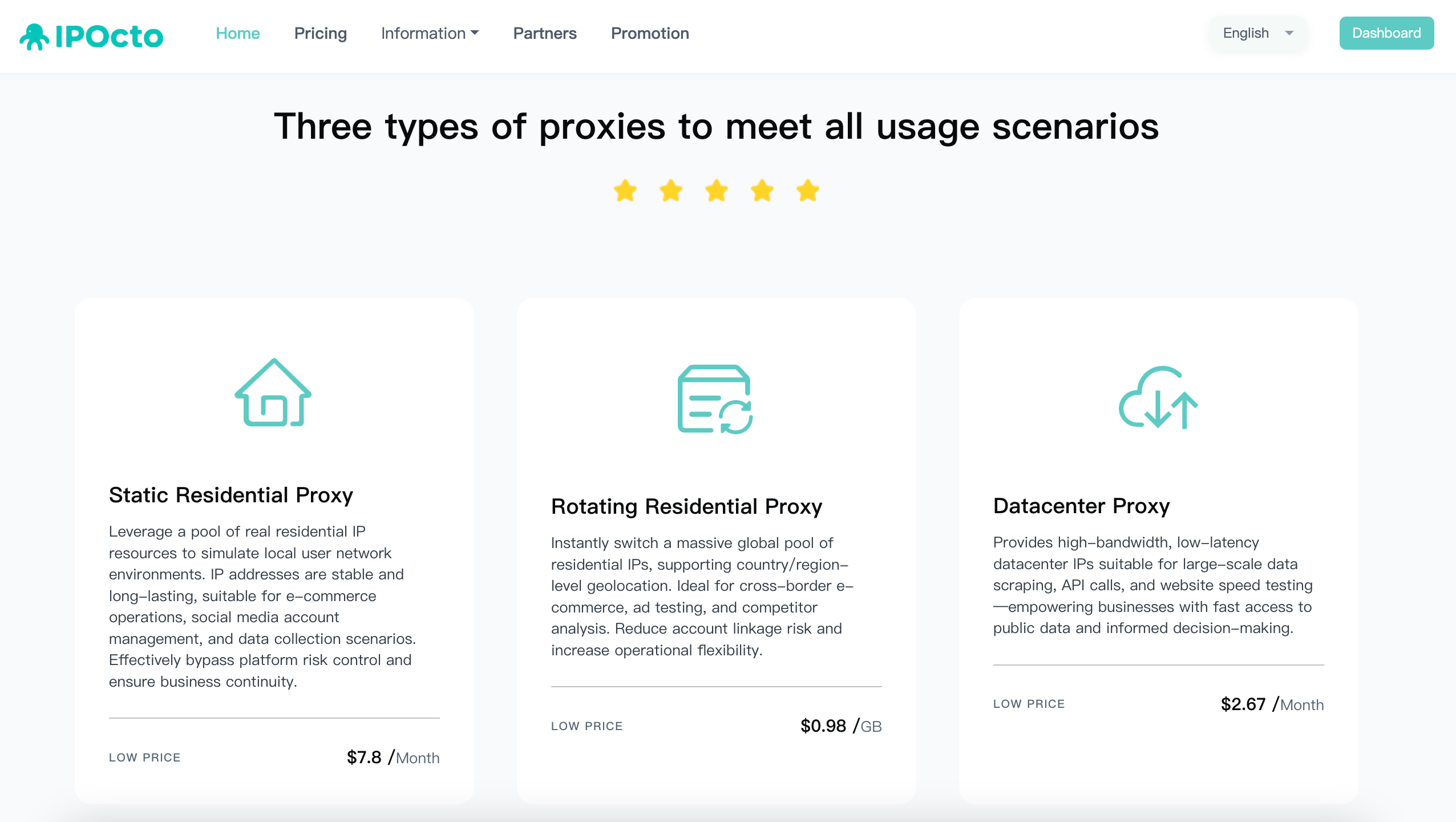
- Static Residential Proxies: The core value is “persistent identity.” It is suitable for scenarios that require maintaining the same digital identity for a long time, such as social media account maintenance and long-term operation of localized stores. Stability is the first lifeblood.
- Rotating Residential Proxies: The core value is “high anonymity and geographical flexibility.” It is suitable for scenarios that require large-scale data collection, ad testing, and competitive analysis, where changing identities and avoiding detection are needed. The breadth of the IP pool and the intelligence of the rotation strategy are crucial.
- Data Center Proxies: The core value is “speed and scale.” It is suitable for large-scale public data scraping, API integration, and performance testing that are sensitive to latency. Cost-effectiveness and network quality are key.
For example, IPOcto clearly distinguishes these three types on its official website and directly links them to specific industry scenarios such as e-commerce operations, social media marketing, and data services. This is in line with market demand. Enterprise customers can combine different proxy types like building blocks according to specific steps in their business flow, achieving the optimal balance of cost, efficiency, and security.
Balancing Global Coverage and Local Compliance
“Global coverage of over 200 countries and regions” has become a standard promotional statement for top service providers. However, the real test lies in the network quality and compliance in key and emerging markets. For example, in emerging e-commerce markets in Southeast Asia and Latin America, the local network infrastructure varies greatly. How to ensure the latency and stability of proxy access? In Europe, how to ensure that IP services comply with data privacy regulations such as GDPR?
This requires service providers not only to have a wide range of nodes, but also to have deep local network integration and support from compliance teams. When enterprises choose, they will pay special attention to the actual performance of the service provider in their target markets, not just the name of a country on the node list. The provision of compliance documents and data processing agreements (DPAs) has also become a necessary part of the enterprise procurement process.
Future Challenges and Integration
Looking ahead, I believe that enterprise IP proxy services will face two core challenges: first, the deep integration with artificial intelligence and automated business processes. Proxy services need to provide more intelligent API interfaces that can automatically trigger IP switching or access strategy adjustments based on business logic (such as encountering CAPTCHA or access frequency limits), becoming an intelligent “decision component” in automated workflows. Second, the further enhancement of security. With the popularity of deep packet inspection (DPI) and browser fingerprint recognition technologies, simple proxy forwarding is no longer sufficient. Future services may need to combine more advanced traffic obfuscation, protocol confusion, or even hardware fingerprint simulation technologies to provide deeper anonymous solutions.
In summary, the connotation of today’s IP proxy services has far exceeded the technical level. It is a comprehensive service that integrates network engineering, data security, regional compliance, and business understanding. For enterprises, choosing a partner is choosing a “insurance” and “accelerator” for global business. The value anchor has firmly been nailed to the ultimate goal of “business success.”
FAQ
Q: How to choose between static residential proxies and rotating residential proxies in practical business?
A: The core is to look at the requirement for “identity consistency.” If you need to maintain a fixed, trustworthy local identity for a long time (such as managing a foreign social media business account or operating a local e-commerce store), you should choose static residential proxies. If your business requires large-scale, high-frequency data access and wants to avoid being tracked and associated (such as batch collecting product information or conducting multi-region ad effectiveness testing), you should choose rotating residential proxies, using the breadth of the IP pool to spread the risk.
Q: How to initially judge the IP purity of a proxy service provider?
A: You can perform a few simple tests: 1) Use its IP to access services like ipinfo.io and check whether the IP type, ASN, and organizational information match the promotion (e.g., residential proxies should show as ISP rather than data center). 2) Use the IP to access websites like Google or Facebook that are sensitive to proxies and observe whether you are frequently required to verify your identity or face access restrictions. 3) Try to perform simple, low-frequency browsing operations on the target business platform (such as Amazon) and observe the account status. Long-term monitoring of account health is the best test.
Q: For data collection businesses, is a data center proxy sufficient? Why is a residential proxy sometimes also needed?
A: Data center proxies have advantages in speed and cost for large-scale data collection. However, with the upgrading of anti-scraping technologies, many websites can identify and block traffic from well-known data center IP ranges. For such highly protected websites, using residential proxies (especially rotating residential proxies) to simulate real user access is a necessary measure to improve collection success rates and stability. It is usually recommended to combine both, using data center proxies to handle high-speed, low-protection public APIs, and using residential proxies to tackle highly protected core data sources.
🎯 Ready to Get Started??
Join thousands of satisfied users - Start Your Journey Now
🚀 Get Started Now - Try It Now